

Meet Matthew Laszacs - Libertarian Party of North Carolina Candidate for US House NC District 2
Matthew's LP National Candidate Page
Matthew's Plan to Fix Social Security
Matthew's Interview with the Tar Heel Libertarian:
Tar Heel: You were born to military parents in Philadelphia, raised in Tennessee, and moved to North Carolina in 2001. As a young father who struggled financially early on, how did those experiences shape your decision to run as a Libertarian for Congress in District 2?
Matthew Laszacs: Just after my youngest son was born, we went to social services to apply for food assistance. At the time, I was working at the FedEx Hub in Memphis at night, delivering pizzas during the day, and desperately trying to stay afloat. I really needed that food assistance. We got called back to meet with the caseworker. She told us that my son’s SSN was already being used by another family for benefits. When we argued our case, she became threatening, accused us of trying to defraud the system, and refused to listen to us.
I am sure we could have fought the system and won eventually, but I had neither the time, energy, nor funds to take it on. It was easier to work more hours and eat less. That’s just one example from my life as a young broke father, and it's not my “why I became a Libertarian” moment, but it was the start of many subsequent state-imposed hurdles and roadblocks to success that ultimately pushed me towards liberty.
When you are poor and every dollar matters, fees, fines and taxes have an outsized effect on your well being. Registering my car and paying property taxes meant not eating for a week. In one instance, I didn't register my vehicle on time. I got a ticket but could not afford to pay it, and the fees and fines stacked up to the point that I had to figure out whether I would instead choose to not eat, not pay my car note, or not pay my insurance. And for what reason did I give up these necessities? To pay an unnecessary tribute to the state for a service that returns no real value to society.
All through my young life I experienced many roadblocks such as these, and they all drove me closer to libertarianism. It occurs to me that being poor can either make you a Libertarian or a Socialist. My case was the former and not the latter. I succeeded despite the unnecessary roadblocks implemented by the state and with very little real help from the state. I wear that as a red badge of courage now.
Tar Heel: You’ve worked your way up to directing a $70 million business while raising two boys. How has your professional experience in building consensus and removing barriers influenced the way you approach politics?
Laszacs: I think I could (and might) write a book about this. The only thing I’ve ever been really good at is somehow getting really smart and talented people to want to do good work for me. It's interesting to me that here in America we are largely capitalists at a macroeconomic level, but individual businesses are, in most cases, some form of dictatorship.
I think Ronald Coase tackled this with his essay The Nature of the Firm, by asking the simple question of, “why do firms exist?” The answer is that markets impose transaction costs, and firms exist to reduce transaction costs. It does not, however, offer insight into the organizational structure and freedom of the employees inside the firm.
My experience informs me that businesses are essentially little “countries” with legal systems and political systems inherent within the company. Most businesses impose top down regulations (company policy) on their rank and file employees and closely enforce it. My thought was (and still is), “why not apply Classical Liberal and Libertarian tenets to the workplace?”
I primarily studied Bruno Leoni and FA Hayek (among others) and I assimilated their insights on emergence into my management style, and applied them to my business to the maximum extent possible within my available span of control. Essentially, I tried to set my people free to unleash and maximize their inherent ingenuity and capabilities.
I reduced their unnecessary policy hurdles and helped them solve internal and external problems. I also made them accountable through measurable and minimal performance metrics, and we met often as a team to solve problems and record which solutions and approaches were the best. I tried to set a realistic target, and then let them freely figure out the best ways to hit the target.
What I witnessed was successful and smart people dynamically solving problems in real time - solutions and policy emerged from best practice, and not by dictate. It has been an amazing experience, and one that I think many businesses could apply successfully with some courage, conviction, and an unwavering belief in their people.
Tar Heel: Your campaign slogan is “Together we can achieve peace and prosperity through less government and greater personal choice.” What does that mean to you personally, and why do you think it resonates in fast-growing District 2?
Laszacs: I am a firm believer in emergence. The best solutions will emerge if we allow people the freedom to innovate and adapt within dynamic systems and environments. I also believe that FA Hayek’s knowledge problem is evident at all levels of society and government. No small group of regulators and policymakers will ever understand our individual challenges and needs better than us.
Needs and challenges are also not static. Sometimes our needs change in a matter of days. Throughout the course of our lifetimes, our needs will dynamically change along with changes in the world and the disparate societies and associations that we are living and participating in.
What we need and want today may not be what we need and want tomorrow. Only the individual can determine how to best apply their inherent skills and talents to earn a living, which types of education and schooling is best for their individual children, what housing they may need, what neighborhood they need to live in, and what their individual definition of “goodness” is for their own lives.
We live in a dynamic world, and static regulation imposed by a small group of well-meaning politicians unintentionally blocks individuals from dynamically adapting to and navigating the complexities of life - ultimately restricting them from choosing their best individual paths through a complex world. We must set people free to the maximum extent possible so they may create rewarding and enriching lives for themselves and their families.
In Wake County and District 02, specifically, we are seeing a huge influx of people to the region. Our infrastructure, housing, and schools systems will continue to feel the strain of our ever-burgeoning population. While the population growth brings challenges, it brings even more opportunity. I love living in such a dynamic region full of interesting people and overlapping cultures and ideas, and I do not want the government to slow that dynamism through excessive regulation. People solve problems, not regulation.
Tar Heel: As a Libertarian running for federal office, how do you explain the principles of individual liberty, personal responsibility, and limited government to voters who are used to the major parties’ big-government approaches?
Laszacs: I find that, when it comes to politics - whether Republican or Democrat - people often want to have their cake and eat it too. We all want something from the government but we don’t want to pay for the associated opportunity costs or the hard monetary costs. Therefore, I try to talk about policy in terms of the trade offs and not the intended benefits. I try to articulate to people what they will lose instead of what they think they will gain.
For Republicans, that might be a discussion around giving up their personal freedom and privacy in the name of national security. For a Democrat that might be a conversation about losing their individual free speech rights for some perceived protections for certain populations. Nothing is free when it comes to law and regulation. We must always give up something to get something in return. That is as ironclad as the laws of physics.
Proponents of government will contend that we only give up a little to get much more, and that is a reasonable theory, yet that it is almost never borne out in practice. I believe that we almost always lose more than we gain, as that assertion is backed up by actual historical outcomes. The actual output of a law, regulation, or agency is almost never what was intended, and almost always takes more from society than it returns. We should be focused on outcomes instead of intentions.
Tar Heel: You’ve said “people are not broken—systems are.” Where do you see both Democrats and Republicans in Congress getting it wrong when it comes to expanding federal power at the expense of liberty?
Laszacs: I am extremely interested in the dynamic between institutional design and institutional emergence; that is, what we think we design is not what we actually get. As Buchanan and Tulloch so expertly identified in Public Choice Theory, people do not stop being people when they enter into government roles. They often continue to act in their own self interests and within the set of incentives they are bound to.
Once an institution or system is designed, an incentive structure is also created. Human beings operating within these systems respond to complex sets of incentives in ways that are frequently unexpected, undesired, or just outside of the original intent of the system. Consequently, the system that emerges is not the system that was originally desired. We can see this emergence across all aspects of our government. I would argue that the current United States government - the one that has emerged - is very different from the one envisioned by the founders at its birth. Emergence, therefore, doesn’t just happen in the free marketplace, it happens in government as well.
I believe if I could ask David Hume (arguably the world's greatest philosopher) if he thought the current United States government was the correct one, I believe he would say, “Yes. Because it is the one that the American People allowed to emerge, and it is the government that the American People tolerate.”
Unwanted emergence happens to systems designed by both Democrats and Republicans. For example, Democrats over the years have tried to design systems to help the poor and provide a social “safety net.” These programs have drifted far from their original intent, have created dependent people, have increased single parenthood, and have largely trapped people in perpetual poverty rather than to help free them from it. Republicans decided that drugs were bad in the 1960s and created systems to prevent drug abuse and overdoses. The system that actually emerged was one of ever escalating violence, no marked decrease in drug abuse, and higher overdose rates. The system of enforcement that emerged is actually worse than the drug problem it originally sought to solve. Institutional drift is very real, and very damaging to American society.
Tar Heel: Congress has increasingly ceded power to the executive branch and the courts. If elected, how would you help reassert Article I powers and restore the constitutional balance?
Laszacs: I think it starts first and foremost with the American people. The Federal Government that has emerged over the past 150 years is one in which the people elect a strong president (their “king”) who will act quickly and assertively through abuse of executive orders and emergency spending to legislate by fiat on behalf of whichever party they belong to. Trump's use of executive action is egregious (480+ and counting), however, it is not novel. When asked about a perceived dilatory congress, Obama famously said, “I’ve got a pen and I’ve got a phone” and proceeded to run the country from the oval office through 276 executive orders plus an aggressive use of agency administrative power. From FDR to Ronald Reagan, throughout history both Democrats and Republicans have loved and supported their respective kings.
Then there are nine unelected politicians running the judiciary and writing legislation favorable to whichever party they belong to from the bench. These politicians are hand picked by the president and their respective party to protect the president’s executive actions as well as the favored policies of the party in power.
But where is congress? They are hiding in the shadows and using the executive and judiciary branches as a shield from the American People. And it is understandable why they do that - because they are responding to what voters want. Voters like it that way. This is the American government that has emerged, and it's the one that voters favor. So it all starts with voters having different expectations for congress. Article I gives Congress a lot of power because it is the branch of the federal government that is closest to the people. We need voters to understand that first and foremost, so that they will elect representatives that will go to Congress and assert those Article I powers on behalf of their constituents.
If elected, I would work from a crawl-walk-run framework to restore congress to the full scope of its Article I powers iteratively:
CRAWL
Restore Congress to the full scope of its Article I powers as intended by the framers. Rein in the administrative state through serious oversight. Reestablish fiscal discipline and curb the profligate use of executive orders and emergency powers.
WALK
Review federal agencies for mission creep and return them to their core functions. Clearly define acts of war and limit executive overreach. Implement fiscal tools such as PAYGO or a Swiss-style debt brake so Congress must prioritize spending rather than simply borrowing more.
RUN
Address long-term structural challenges honestly. Reform Social Security, a system that cannot sustain itself indefinitely and increasingly burdens younger Americans. Clarify the jurisdiction and operation of the judiciary. Replace the federal income tax with a simpler, fairer, and more transparent consumption tax.
Tar Heel: You strongly support expanding educational choice—Educational Savings Accounts, vouchers, scholarships, and ending the “outmoded, racist, and classist” school assignment system based on street addresses. How would you push to get the federal government out of local education and return power to families and states?
Laszacs: I am strongly in favor of NC implementing a full Educational Savings Account program. Vouchers are a good first step but they are not enough to allow the necessary private education infrastructure to emerge. Setting parents free to spend their educational dollars on the education programs of their choice for each of their individual children is the goal. But that is a state level issue.
At the Federal level I think first and foremost we should remove the leash that accompanies federal spending on state schools. The Federal government spends very little money directly on state education (maybe 10% to 15% of total budgets) yet wields an outsized amount of control over states due to the strings attached to that money. DC sends WCPS a dollar, expects 30 cents back to cover the bureaucracy, then dictates to WCPS what to do with the remaining 70 cents. We should remove the politicization of any federal spending on K-12 public education by converting the spending to block grants with no strings attached.
Then I think congress needs to roll back the No Child Left Behind Act and the Every Student Succeeds Act. The Federal government really has no place in determining how individual states and school districts determine success and accountability. Those decisions should be left to the states.
Tar Heel: On the economy, you want to slash occupational licensing, zoning laws, and other regulations. What specific federal reforms would you pursue to make it easier for businesses and families in District 2 to thrive without excessive government interference?
Laszacs: I believe that zoning is largely a state issue, and I am actually against congress or the president enforcing any kind of zoning rules on states. I believe that there is a strong case to be made that federal interference - even though well intentioned - would cause more problems than it would solve.
Occupational licensing is an interesting area. The vast majority of occupational licensing regimes are run at the state level, however, a handful of occupations that traverse across state and international borders are subject to federal licensing.
A few that come to mind are the FAA (aviation licensing), the FCC (radio operator licenses), the NRC (Nuclear plants and related industries), and even the US Coast Guard (Merchant Mariner licenses). All of these industries arguably need safety, standards, and compliance. The relevant classical liberal question, however, would be, “is the government the best mechanism for ensuring these outcomes?”
I would not support an elimination of any of these federal licensing regimes, however, I would prefer that Congress defined the outcomes, and then federated the operational aspects of licensing out to the private marketplace. This would not sacrifice safety outcomes but would create a more efficient, and possibly less expensive licensing regime. Or it would better balance the risk against the licensing cost and the demand to allow the correct operators to emerge more efficiently. From a directionalist standpoint, this would be a move in the right direction without wholesale elimination of arguably necessary safety regimes.
Tar Heel: Healthcare is another area where you emphasize choice and competition. Walk us through your plan to ease federal rules, lower costs, and give patients and providers more options.
Laszacs: One of the most critical ways we express our freedom is by deciding what products and services to purchase. In many ways, consumption tells the story of who we are as individuals. We will agonize over what television to purchase, what video games we love and hate, and what movies to watch. We deeply research and then move to cities, towns, and neighborhoods that reflect our individual values or provide employment opportunities. We dress our homes up in decorations that reflect our individual tastes and preferences. We spend a lot of time researching these purchases and then we exercise final control over the purchase at the point of sale by exchanging money, or selecting a preferred vendor to finance the transaction. We are in control of the selection and monetary exchange.
We exercise this control for the vast majority of our purchasing decisions, with the odd exception of healthcare purchases - odd because these are some of the most personal, intimate, and critical purchasing decisions we will make in our lifetimes. Yet we remain passengers in most of these decisions while the third-party intermediaries of the Government, the insurance companies, and our employers make almost all of these critical spending decisions for us. What a strange system that has emerged in modern American healthcare. The evidence of the widespread benefits that consumerism has on improving quality, selection, and price in literally every other sector of the economy is overwhelming, yet we willfully suspend rationality when it comes to healthcare.
The Cato Institute has done an incredible job of detailing the history of the rise of our modern, employer sponsored insurance driven healthcare system, so I will not belabor that, but I will try to summarize it in my own words. In the 1930’s, healthcare was largely purchased directly from providers by individuals. Although some insurance providers did offer health coverage, it was not widespread. This is one of the reasons why mutual-aid societies developed in many communities. In addition to providing other member benefits, they pooled risk across members to pay for funerals and survivor benefits, and often expanded those benefits into healthcare. These societies were extremely responsive to their constituents, because they were more directly controlled by the constituents, and were developed in smaller communities that were formed largely around trust. I myself belonged to one of these mutual aid societies as a child, the Hungarian Reformed Federation of America (HRFA), which was developed to support Hungarian immigrant families in the late 1800s.
During WWII, the government imposed wage controls on businesses in an effort to prevent inflation. Because of this, many businesses expanded their fringe benefits (such as health insurance) to attract scarce workers. For example, they could not necessarily pay an employee $1000 dollars in additional wages, but they could provide that employee with $1000 of health insurance.This led to a rapid growth in employer sponsored healthcare that was further institutionalized by the government once the employer sponsored health insurance exclusion was codified into law in the 1950s. Through the 1960s and 1970s, the government implemented and grew Medicare and Medicaid, and the system that emerged was one where the government created the incentive structure that largely led to our bizarre modern healthcare system. This leads us to the present day, in which the Cato Institute estimates that 90% of our healthcare expenditures flow through third party intermediaries, while individuals only pay approximately 10% out of pocket.
This has created an environment in which consumerism is almost absent from our healthcare purchasing decisions, as where we actually spend our dollars should shape how products and services evolve for the better; but when third parties - each with their own set of incentives - spend the money, they do not necessarily spend it where the actual end consumer would. At best this is a market distortion, at worst, it is misaligned incentives driving prices up and misallocating healthcare products and services against actual demand. I have furthered the Cato Institute’s study to make an even bolder claim; that spending is tantamount to decision-making, and in our current system, the decision-making is furthest from the people that should be making the decisions - the end consumer.
The following illustration attempts to show the disconnect between individuals and their healthcare decisions:
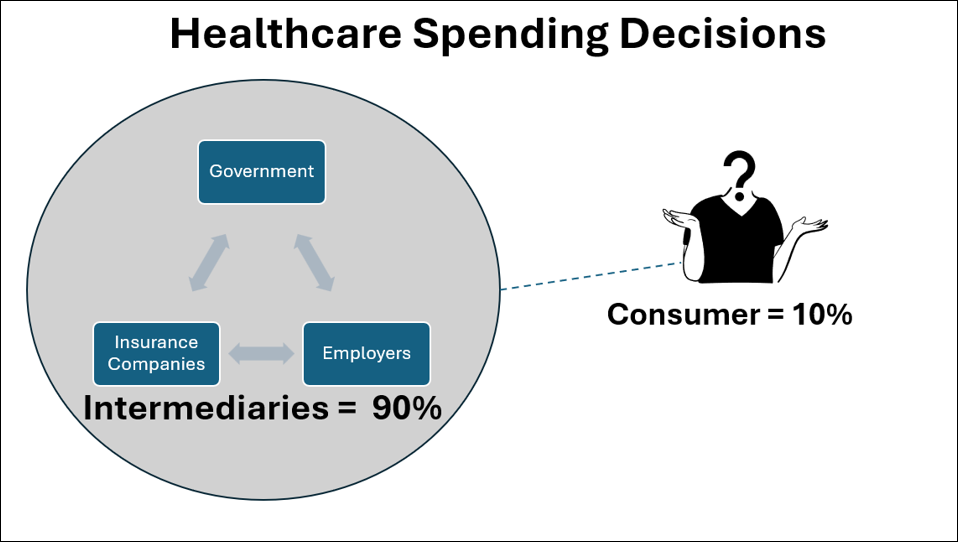
My approach is to return the benefits of consumerism incrementally to our healthcare system and put the individual back in greater control of their own individual healthcare spending decisions and outcomes. We need to change the incentive structure to allow this increased consumerism to emerge on its own without government dictate. The government cannot effectively force doctors and insurance companies to be more responsive to consumers, nor force them to develop better, more affordable services - but we can change the broken system so that these positive behaviors may develop on their own as we let human beings and the marketplace go to work to improve the system naturally. It must be noted that a great many people enjoy their current healthcare plans, and will be resistant to change, even beneficial change. We must employ a crawl-walk-run approach if we hope for long term success.
CRAWL
Give Medicare and Medicaid beneficiaries a financial stake in shopping
-
Identify planned and routine (shoppable) services and set a threshold spending target
-
Allow beneficiaries to shop for competing services
-
If a lower-cost service is selected, the beneficiary receives a share of the savings as a monetary benefit (could be a lower premium or even a direct cash payment)
-
If the consumer selects a higher cost product or service, it may be that there is a perceived benefit to the consumer from the selected service. Just as in any functioning marketplace, providers can differentiate their products and services to compete, and some may elect to provide a "Cadillac" option instead of a “Ford” option.
-
The net result in time would be providers adapting their products and services to be more competitive (due to injection of market forces)
-
Some consumerism is injected into government subsidized health insurance
*Note that since medicaid programs are largely run by states, we would create the law at a federal level, but allow individual states to “opt-in” so that we stay aligned with the spirit of federalism.
*Medicare could be tailored by individual insurance providers in the spirit of discovering which products and services best meet the needs and preferences of consumers through trial and error.
WALK
Create a new portable, National, Tax Exempt Individual Health Savings Account that is improved from our current HSA structure
-
The account belongs to the individual and is not tied to an employer
-
The account is not tied to a specific health insurance plan
-
Individuals are still free to purchase health insurance individually or to receive it as an employer provided fringe benefit if desired
-
Like an HSA, the account can be rolled over indefinitely, invested in mutual funds, and used to supplement retirement
-
Funds can be used for any legitimate healthcare expense, including to meet a deductible from an employer sponsored plan or to purchase an individual plan, or directly from the provider
-
These accounts would help bridge the gap between employer provided healthcare plans and a transition to individually purchased healthcare plans
-
A moderate amount of consumerism is injected into the entire healthcare industry
RUN
Eliminate the tax exclusion for employer purchased healthcare plans
-
Offset with individual tax exemptions for healthcare expenses (like the national Health Savings Account) or the purchase of individual healthcare plans, or the purchase of services directly from the provider
-
Employers could still offer healthcare plans as a benefit (just no longer tax exempt), as the risk pooling they offer may still lead to lower costs for enrollees
-
Consumers now have much more control over their health spending, consumerism is widespread within the healthcare industry
-
New and better services develop
-
Providers become more efficient
-
Innovative healthcare insurance plans should emerge
-
Small businesses should flourish with the removal of a huge barrier to entry and growth
The intent of this incremental plan to restore consumerism in healthcare isn’t to spend more money, or even to allow “laissez-faire” in the marketplace; it is to restore control over healthcare decisions to those closest to the information needed to make the decisions - patients and doctors. It is about shifting who controls the ability to positively shape our healthcare marketplace to those that are best suited to do so. It is about returning power over our individual healthcare choices directly to American citizens.
Tar Heel: The national debt and entitlement programs like Social Security are unsustainable. You’ve proposed ideas like a Swiss-style “debt brake.” How would you address the Social Security funding shortfall without unfairly burdening future generations?
Laszacs: Outside of the national debt and Medicare, Social Security may be the single largest problem our Congress is facing. It is the quintessential example of failed institutional design coming back to haunt us - repeatedly.
Our predecessors designed a system that relied on population growth to sustain itself. At the time of its creation, there was a presumption of continued population growth and demographic expansion. Our forebears assumed that there would always be more workers to replace current workers. They were wrong, and history has an annoying tendency to disprove our assumptions about future human behavior.
What actually transpired is that population growth around the world slowed and in some cases, actually started shrinking. The United States has been below the replacement rate for many years now, and immigration has become our primary driver of long term population growth. Add to that the demographic challenge of the so-called “baby boom generation” and other older populations beginning to retire while living longer, and this has resulted in our current situation where there are not enough workers to pay for the benefits of current and future retirees. In addition, younger Americans are increasingly saddled with a greater share of the tax burden relative to the number of workers while almost certainly facing a reduction in benefits, creating unnecessary social tension between the generations.
The challenge is even further exacerbated by the fact that the majority of Americans, historically, have not been incentivized to do anything about it. After all, no one wants to lose benefits. In addition, many (if not most) Americans falsely believe that they have “Paid into Social Security” and should get back from the system what they put into it.
Social Security has absolutely no personal savings account or functional savings mechanism tied to it. The trust fund is Treasury securities that represent claims on future taxpayers and should not be misconstrued as a personal savings mechanism. Further, it is reasonable to reduce the trust fund to its simplest definition - debt for future generations.
Social Security is a transfer system, but many people understandably believe that, after years of paying taxes, that they should get what is rightly coming to them.
Americans also largely dislike other factors that could help alleviate the mathematics problem, such as increasing legal immigration or allowing AI to fully develop without restrictions.
Increased legal immigration helps the mathematics question - more people in the population improves the worker to retiree ratio. AI is more complicated, but there is a strong case to be made that the productivity increases and innovation of new industries that emerge from AI could help offset some of the funding deficit. Similar to the lightbulb, the internet, and automobiles, AI is a groundbreaking innovation that follows Schumpeter’s creative destruction framework. The long term productivity gains from AI could be absolutely essential to help offset the financial implications of a declining population.
Finally - and perhaps most depressingly - we could have solved the problem in the past, and several viable solutions have been presented over the years, but none of our previous congresses had the political will to push them through because a majority of the American people, for all of the challenges identified above, simply did not support them. Now it is too late to “solve” Social Security without everyone taking an intolerable haircut in the process.
We get the government we deserve. We allowed our government to build a system with no real individual ownership, and we have allowed ourselves to become passengers handcuffed to the seat of a train that is careening towards disaster.
The result is an impending train wreck. We know the wreck is coming, it's not too far down the tracks…maybe even right around the next bend. It is going to be a gratuitous and fiery explosion. We also know that it is too late to prevent the train from crashing. However, we can slow the train down to minimize the damage.
That is the current situation the United States Congress finds itself in. Yes, our predecessors lacked the political will, perhaps the courage, to solve the problem when the opportunity presented itself, but we currently do not find ourselves in a position to kick the can down the road any further. We must act with courage and conviction, engage the American people in an open and honest conversation, and bring together younger and older Americans for a shared plan to address Social Security.
If any institution is to remain viable, however, it must be designed to be resilient to unforeseen changes. Politicians have demonstrated time and time again that they are the world's worst prognosticators. Therefore, we cannot enact static, fixed legislation, and we must revisit it regularly in the future to evaluate performance against expectations and correct the course.
In addition, if we are to build an institution, then that institution’s main focus should be empowering individuals to maintain an ownership stake in the future success of the system.
The short term project for social security is stabilizing the current system to preserve the safety net and protect the benefits of older Americans while limiting the burden on younger Americans. Everyone will have to share the burden in the short term.
The long term project for social security is to create a gradual transition “off ramp” to an ownership system for younger Americans - a real savings system. It can be done. Different versions of these same ideas have been undertaken in Sweden and Australia, demonstrating that retirement systems can evolve over time while preserving a safety net.
Understanding that Social Security is an extremely difficult nut to crack, we must ease the American people into a better future. Below is my crawl-walk-run plan for implementing this incremental change to our Social Security system:
CRAWL
Stabilize the system (Solve the math problem)
-
Change how we speak about Social Security. Educate Americans about what it is and what it isn't. It is a transfer program. It is not a savings program.
-
Define social security as purely a mathematics problem, and not a political problem. Remove the vitriol between the generations by correctly defining the nature of the problem.
-
Define what the vision for a future Social Security program is. If it is to primarily be an old age poverty prevention program (safety net), then design the system to that primary goal. If it is to be a general retirement savings and investment plan for young Americans, then design it to that primary goal. Perhaps it is both (my suggestion). Agreement on what it should be is critical to properly developing it.
-
Create a non-partisan commission to review social security and recommend a set of stabilization changes. This would give Congress political cover while allowing the hard decisions to be made and the changes to the law implemented. We need to preserve Social Security while ensuring it remains in place for future generations.
Suggested stabilization changes:
-
Means Test current benefits so that high-income retirees do not draw benefits that they do not need
-
Index future benefits calculations to inflation (CPI) instead of wage growth, since wages tend to grow faster than inflation over time
-
Gradually raise the retirement age based on life expectancy
-
Protect low-income retirees from benefit losses
-
Implement automatic adjustment triggers that “self-correct” the system dynamically without political influence. These triggers would operate from feedback mechanisms that adjust up or down based on changes in actual future conditions such as:
-
Demographics changes (perhaps there is another baby boom or a net immigration increase)
-
Economic changes such as CPI, productivity growth, payroll tax receipts
-
Financial changes such as deficit increases or decreases
-
The focus in the crawl phase is not just stabilizing the system, but addressing the known failures of institutional design in the current system. The crawl phase addresses the failure of static design in legislation. We instead seek to create a system that lays out goals and provides a non-partisan mechanism to automatically address changes in the future. The implementation of automatic feedback mechanisms is critical to preventing the types of failures that we see with our current Social Security system.
WALK
Construct a replacement retirement system for younger people to bridge the gap.
-
Create automatic enrollment Federal retirement savings accounts (with opt-out)
-
Government provides a match for lower income workers
-
Savings accounts operate as tax-free growth accounts
-
Savings accounts have a simple index fund default (similar to TSP)
-
Savings accounts are portable across jobs and are owned by the worker
The Walk stage is critical for addressing the continued stability of the safety net while providing individual Americans actual ownership in their financial destinies. When individuals have a real stake in their future, they are more likely to participate directly in the future growth of the economy.
Maintaining a social safety net while encouraging ownership is a powerful combination that is absolutely politically viable. The challenge to date has been to provide an “off-ramp” for those that would like to transition from the current social security system to a retirement account while preserving the safety net for those who still need it. I believe the activities in this phase answer both of those concerns with distinct, but complementary approaches.
RUN
Fully transition the population to savings accounts and Social Security becomes purely a safety net.
-
Enact “transition credits”
-
Workers receive recognition for benefits already accrued in the existing system up to the time they elect to transition
-
The value of the credit decreases over time to encourage early participation in the new savings system
-
Delaying transition imposes additional costs on the new system, therefore early adopters are rewarded for making the transition easier and less expensive for everyone else
-
-
As more younger Americans enroll in the savings account in time, the original Social Security plan becomes a safety net only
-
Most retirement income comes from the savings accounts
-
System becomes mathematically stable
-
Younger generations build real assets instead of relying on demographics
Reforming Social Security may seem impossibly hard, overwhelming, or unmanageable, but if we focus on it as a shared math problem, then we can come to a resolution. We don’t need to end the social security project, but we absolutely need to fix the broken system it has become. This plan focuses on preserving it as a safety net while making critical changes to its structure, and providing a long-term pathway for younger Americans to build real retirement savings that they actually own.
Tar Heel: Federal spending and deficits are crowding out priorities. How would you use tools like a real budget and spending caps to restore fiscal discipline in Congress?
Laszacs: Imagine you have a very large family and every member of that family wants things. You wouldn't buy them everything they wanted, because if you did, that would be a surefire way to run your family into bankruptcy. Instead, what you do is budget and plan spending, so that all of your family members get some, but not all, of the things they want. You also save money when times are good to cover your expenses when times are rough, and you borrow wisely for large family investments such as a home, cars, and education.
I believe that Congress should follow this same, simple logic when it comes to prioritizing spending; but you have many people who will claim that the government is NOT like your family because they can tax and borrow into perpetuity.
Okay then, let’s imagine that you also have these same, massive government powers to apply to your own family finances. Let’s imagine you can engage in limitless borrowing, tax your neighbors to raise revenue, and print your own money.
Borrow too much money, and the future interest that has to be paid by your children becomes a disproportionate share of their budget, effectively crowding out their own personal spending priorities. Tax your neighbors too much, and they will rise up against you and revolt. Default on your loans, and people stop lending you money, or lend it at much higher interest rates. Print your own money to cover your debt obligations, and you devalue you the money to the point that you, your children, and your grandchildren have less spending power - in other words, inflation.
Even with the awesome power of the government, you just cannot escape constraints. We live in a constrained world. Congress needs to come to terms with this hard reality and stop spending our children’s and grandchildren’s money without their permission.
I think many members of Congress (past and present) are laboring under the delusion that debt is merely a financial issue, and that the numbers don’t really matter because the government has the power to tax, borrow, and print. While that works for a time (and arguably a long period of time) we eventually have to pay the piper. We are experiencing this now. Interest payments on our past debt now account for a larger share of our budget than National Defense. Every dollar we pay to interest is a dollar not spent on our current priorities. Our forebears spent our money without our permission, and committed us to paying interest instead of funding many of our priorities - effectively limiting our choices and most importantly, our liberty. Debt eats future choices for lunch.
This is why I wholeheartedly support any kind of spending prioritization rules for Congress. We simply cannot have everything we want. In a more perfect world, we - the voter and taxpayer - would be more directly involved in voting for our preferred spending priorities. This would be more akin to the Swiss style of government.
We should fund “upwards.” That means that a majority of our taxes are collected first by our local, then state governments, and the Federal government is funded upwards from there. That would help ensure that our taxes are allocated more closely to where the funds are actually needed, and would push decision making on spending (and therefore control) closer to States and local communities. This is not unprecedented - Switzerland has a very similar structure.
That, however, is a destination and not a direction. In the meantime I would like to see Congress enact spending prioritization tools such as a Swiss-style debt brake, or a Paygo-style approach.
The Swiss debt brake, in my opinion, is the gold standard for managing spending. The Swiss Debt Brake is a system that ties government spending to expected tax revenue over the business cycle. It allows temporary deficits during recessions but requires surpluses during periods of economic growth, ensuring that the budget balances over time rather than every year. The result is a system that encourages long-term fiscal discipline without preventing governments from responding to economic downturns. In simple English - it forces Congress to live within its means while saving money during good times, but also provides them the ability to spend money during bad times.
While I understand that the Constitution does not require congress to create a budget every year, it also doesn’t say that they shouldn’t. It also doesn't say that Congress is free to spend our grandchildren’s money without their permission. That, to me, is fundamentally unjust. We are literally stealing the agency from our grandchildren to fund our own priorities now. It is wrong and it needs to stop.
Tar Heel: As a Libertarian, what’s your stance on U.S. foreign policy, military interventions, and endless wars—should Congress reassert its war powers and pursue a more non-interventionist approach?
Laszacs: First and foremost, I think that Congress needs to reassert its Constitutional power to declare war. The Framers of the Constitution intentionally vested this power in Congress because they wanted the body of government closest to the people to make that decision, not an individual president.
That said, I do believe in a strong national defense, and I am a strong proponent of maintaining a well trained and well funded military. This is not out of line with classical liberal thought. Adam Smith was also a proponent of maintaining a professional military as opposed to militias. In The Wealth of Nations, he details why a professional military is a necessary prerequisite of commerce, and I largely agree with him that a professional military is an essential function of the state.
I do, however, agree that Congress should reassert itself in the decisionmaking process to go to war. Although we may find Trump’s recent actions in Venezuela and Iran to be questionable - they are not, in fact, novel. Recent past presidents, including Bush, Obama, Biden, and Trump have all very broadly interpreted their Article II powers, and have very effectively skirted around the language in the War Powers Resolution of the 1970s. Every “king” we have elected in recent history has acted somewhat unilaterally without much input or pushback from Congress or voters. For example, Democrat voters were largely supportive of Obama’s drone strikes, and Republican voters generally are supportive of Trump's actions in Iran.
In addition, Congress largely fades to the background and quietly funds these actions with very little real interference. Perhaps they do not want to be seen as slow and indecisive, but I suspect it's just because we, the American voters, like it that way. We love to see our king of choice acting decisively to stick it to the bad guys, yet we dislike it when the other king acts similarly.
I think the best next step is for Congress to seriously revisit the War Powers Resolution, and tighten the language in actionable ways that give the law some actual “teeth.” Currently, the law as written does not significantly obstruct the president from acting unilaterally. I think the Overton Window has shifted to the point that the public will finally tolerate both a serious debate around Presidential War Powers as well as defining real legal limitations on that power. Congress just needs to be responsive and push that debate and subsequent law through the chambers. Strike while the iron is hot, as they say.
Tar Heel: Immigration is a major national debate. Where do you stand on border security, legal immigration reform, and reducing federal bureaucracy that hinders both?
Laszacs: We need to raise the quotas for legal immigration into our country while maintaining security at the border. Border security should come first and should be our primary focus; however, we cannot successfully reduce illegal immigration unless we also address the fact that too few people are allowed to immigrate legally. We need to address the supply and demand issue to alleviate the ever-burgeoning surge of illegal immigrants at the border. Years of restrictive quotas on immigration have created an untenable enforcement environment. Too many people want to come in, not enough are allowed in legally. We must address both sides of the equation: secure the border and increase legal pathways to citizenship.
We need immigrants. Years of shifting demographics are creating real challenges for us both economically and from a policy standpoint. Many of our systems have been built around a perpetually growing population, yet births have been below the replacement rate since the mid-2000’s and net immigration has become the primary driver of long-term population growth in the United States.
Immigrants, both poor and wealthy, are good for the United States. Our current immigration quotas are built primarily around bringing wealthy and educated immigrants into the country, but that is a shortsighted policy. Yes, we need educated immigrants - the best and the brightest - but we also need laborers, dishwashers, agricultural workers, childcare providers, and other similar roles that many immigrants play in a well functioning society. Restricting the supply of these workers actually drives up prices and reduces the availability of these services to the American people, making our lives harder.
Furthermore, people (including immigrants) do not exist in permanent stasis. They learn new skills, become more efficient, buy homes and cars, pay taxes, raise children and educate them, and generally build better lives for themselves and their families. By doing so, they not only contribute to the American economy and benefit the Americans who contract with them for their products and services now, but their children and grandchildren continue to provide benefits to our country into the future. Today’s farmers and dishwashers beget tomorrow's doctors, scientists, and business leaders. More people means more innovation and more economic growth. People are good. And if we are not going to supply them naturally, then we should import them from elsewhere.
We do not need open borders, but we do need an immigration system that brings more people into this country legally and allows them to become part of the American fabric. Illegal immigration actually incentivizes people to act like temporary citizens, and to send their money “back home” instead of investing it here - because they correctly perceive that they have no long-term future here.
It is not without precedent. For much of this country’s history, there were relatively minimal Federal laws for legal immigration. For the most part, so long as an immigrant was not a criminal or seriously ill, they were let into the country. These were the people that became the woven tapestry of America. They built our economy, fought in our wars, and helped to make us the greatest country in the world.
Immigrants are good for us and our future. We need an orderly, functional immigration system that allows more people into this country to help us continue to grow and prosper, while maintaining security at the border. It can be done, but we first need the American people to embrace legal immigration instead of fearing it.
Tar Heel: Criminal justice reform and the war on drugs remain key Libertarian issues. Would you support federal efforts to reduce sentencing, end cannabis prohibition nationwide, or reform asset forfeiture?
Laszacs: I support all of the above. Before I fully answer this question, however, I want to point out that law enforcement officers are not the problem. They are truly our heroes in the street putting their lives on the line to help keep us safe. There is a disproportionate focus on reforming law enforcement when the real root problems of our criminal injustice system lie within the system that prosecutes crime. That doesn’t mean that we shouldn't address concerns with law enforcement and shape better policing practices. For example, Qualified Immunity and asset forfeiture return no value to society and should be ended immediately. But again, the real root-cause issues are upstream of the police and must be addressed if we are to fix our broken injustice system.
At least half of the Bill of Rights was written to specifically make it difficult for the US government to put people in cages, yet in the United States today, we imprison a greater percentage of our population than every other developed nation in the world. Rationality and logic informs us that US society likely isn't producing that many more criminals per capita than every other developed nation in the world. That then begs the pertinent question of, "What are we doing wrong?” With minor investigation of how our system actually operates, the answer becomes simple: the justice system that has emerged in America is one purpose built for speed and efficiency of locking people up, not for administering actual justice and we, the American People, like it that way.
First and foremost, we need to give people their day in court. The founders could never have imagined a United States that resolved 98% of its Federal criminal cases via plea bargain. The Constitution and Bill of Rights were written with the express intention of a trial by jury for all criminal cases, yet today, almost no one gets their day in court. The accused are placed in jail, denied sufficient counsel, have charges stacked against them to drive up the punishment, and are then told that they can be given a lesser (yet still significant) punishment if they plead guilty without going to trial. In this scenario, the deck is so strongly stacked against the accused that in most cases they literally have no recourse but to accept guilt. In this system, actual guilt is never really determined, it is coerced, and society never actually receives any real justice from the system.
Second, we need to elevate the jury to its true role as an independent check on government power. Juries were never intended to be relegated to the overly simplistic role of mere fact finders - they were intended to be a serious participant in the adjudication of criminal cases. Because an acquittal generally cannot be overturned or appealed by the government, juries have the de-facto final say not just on guilt, but on whether the crime committed warrants the punishment.
In most cases, juries today are told by the state that they are not to be made aware of the punishment ahead of time, that they must only listen to the facts of the case, and that their only job is to apply those facts to a guilty or not guilty verdict. Juries are almost never informed of their role as the final adjudicator of justice - that they have the power to acquit even when the evidence supports a conviction.
This role of the jury was well established prior to the writing of the Constitution, and the framers viewed the jury as an essential check on government power, yet the role of the jury has been intentionally watered down by a system that prioritizes speed and high conviction rates over true justice. We should return to the classical liberal insight of, “Who decides?” The jury ultimately decides what the verdict is and serves as the final check on the judge and prosector. In order to decide correctly, jurors should be educated and informed of the full scope of their role in the administration of justice. Or at least not told to only be mere fact finders.
A well functioning criminal justice system should be solely focused on administering actual justice, not on efficiently putting people in cages. There should be a quality-over-quantity approach. If the state brings charges, then it should be prepared to go the distance; it should follow the constitution and give defendants their day in court with a well informed jury of their peers.
There is so much wrong with our criminal justice system that it would require books to cover, so far I have focused solely on what I believe to be the root of the problem and outlined a destination. I will now lay out, as I like to do, a crawl-walk-run approach to restoring justice to the justice system
CRAWL
Pick the low-hanging fruit.
-
Write legislation to end qualified immunity. No one is above the constitution. If a government official infringes an individual's rights, there should be a mechanism in place to hold them accountable to the Constitution. Since the Supreme Court created this ugly baby yet has consistently refused to take any responsibility for it, Congress should step up, assert its Article I powers, and write legislation that shapes how the courts operate.
-
End civil asset forfeiture as well as asset forfeiture sharing. Property cannot commit a crime, therefore it cannot be charged with a crime and seized by the government without any due process of the law. Criminal charges should be brought against people only. If that person is found guilty, then the state can seize any assets associated with the crime - after adjudication. All proceeds from the sale of seized assets go to the general fund and can never be allocated directly to the law enforcement agency that seized them. There should be no perverse monetary incentives to selectively enforce crime. Civil asset forfeiture is immoral and patently unjust. It returns no value to society and creates unnecessary mistrust of our law enforcement agencies and officials. It must end.
-
Reclassify Marijuana as a Schedule III drug. President Trump has already issued an executive order to expedite the rescheduling, and Congress should act to address this legislatively.
-
Reclassify Psilocybin and LSD as Schedule II drugs. Both have shown strong potential as therapeutics for several diseases, including relief from PTSD symptoms for our war heroes and veterans.
-
Clear the federal criminal code of all unnecessary and overlapping laws. We must address overcriminalization. There are too many crimes.
-
Narrow the function of administrative and agency courts to small fines only. No crimes can ever be prosecuted in an administrative “kangaroo court.” All crimes are to be adjudicated in Article III courts as the constitution intended.
-
Limit pre-trial detention to only the worst offenses and to offenders that have a history of not showing up in court.
-
Close the gap between what punishment a prosecutor can bring versus what they can offer as a plea bargain. For example, a prosecutor cannot threaten 20 years and offer only 3 for a guilty plea. The disparity between the threatened punishment and the bargain must be drastically reduced so that the threat cannot be used to coerce a plea.
WALK
Transition justice to the tort system and enact tort reform. Deschedule many drugs.
-
Reclassify most felonies as lower level offenses such as misdemeanors. There are too many felonies. Felonies were originally intended to only be the worst of crimes, yet almost all offenses can be or are a felony today.
-
Many minor and nonviolent crimes should be relegated to either fines only or sent to civil courts to be resolved directly between the parties. So many of these can be successfully resolved with tort law, and the victim made whole through financial compensation, instead of clogging up our criminal system.
-
Enact serious tort reform. The tort system, over time, has developed from a well functioning machine for directly resolving disputes between parties to a system of legal blackmail. Today’s civil courts are prohibitively expensive for the average citizen to access. The tort system needs to function efficiently so that it can swiftly administer justice to the American people as envisioned by the founders.
-
End plea bargaining. All criminal cases go to trial.
-
End jury instructions that are not aligned with the original intent of a criminal jury. Congress should prohibit federal judges from instructing juries that they are merely finders of fact or that they must disregard the justice of the outcome. Jury instructions should accurately reflect the constitutional role of the jury without diminishing its historic function as an independent check on government power.
-
Write legislation that requires the judge to inform the jury of the punishment before going to trial. A jury cannot fully evaluate the justice of a conviction if it is intentionally kept ignorant of the consequences of that conviction.
-
Begin a process for reclassifying most, if not all drugs to Schedule III or lower. Many drugs are descheduled completely.
RUN
All criminal prosecutions occur in Article III Courts with a fully informed jury. Drug prohibition ends.
-
End all drug prohibition. We recognize that drug usage is a social problem, not a criminal problem.
-
End all prohibition of other victimless behaviors. All crimes must require clear harm to another human being or their property. Even then, most of these should be handled by the tort system.
-
There are very few felonies, and very few crimes overall. The entire federal criminal code can fit within a few volumes or in an easily searchable and understandable public database. Congress does not create new crimes that overlap with previous crimes.
The purpose of the criminal justice system should be to maximize justice, not convictions. It should also protect the constitutional rights of every American. Those two goals do not exist in conflict with each other, and in fact, are necessary components of a well functioning criminal justice system. We must strive to return justice to the justice system.
Tar Heel: Guns and Second Amendment rights are often contested at the federal level. As a Libertarian, how do you view any new restrictions, red-flag laws, or efforts to protect constitutional carry?
Laszacs: The Second Amendment is pretty clear that we possess the right to bear arms, so when you think about it, 2A is a Federal constitutional carry for all citizens. This right should not be restricted by states and localities simply because they don't like it. I see all of the rights in the bill of rights as equally important, and to be left without restrictions. The constitution does not say, “...to keep and bear arms unless found to be mentally unstable or cannot pass a background check.” Critics will say that the bill of rights doesn't talk about machine guns and explosives either, but that argument fundamentally transforms the constitution into something it is not. It is a full permission document for citizens and a power limiting document for the government - not the other way around. In the ninth amendment, it even says that rights are too numerous to be accounted for in a single document.
There is a process in place to amend the constitution. If Americans want to restrict our 2A freedoms, then they should follow that process instead of writing laws that limit rights in advance while hoping that courts don’t overturn it.
Even though, as an originalist, I believe that 2A is our de-facto constitutional carry, I would like for Congress to enshrine that definition of 2A into actual legislation. It is a kind of novel idea; to write legislation that clarifies our understanding of the meaning of a provision of the constitution to be exactly what it says - no more, no less.
I would also support a Federal Sensitive Location Carry law that allows citizens that undergo rigorous initial and ongoing training and a background check (at their own expense) to carry concealed weapons on airplanes, trains, in school zones, concerts, parks, and other sensitive locations. We need more citizens that are trained and ready to respond to active shooters who frequently like to target these types of no-gun zones.
Tar Heel: Abortion remains divisive post-Roe. How do you balance Libertarian principles of life and individual liberty when it comes to federal involvement or funding?
Laszacs: I am personally against abortion, however, I also believe that abortion is a social issue that is best left to families, churches, physicians, and communities to resolve. The government lacks the tools to precisely regulate abortion and it should not try to do so.
Federal funding of abortions (such as medicaid) is more difficult because it is extremely hard to quantify through legislation when an abortion is medically needed and when it is not. For that reason, I support the simplest of rules to try to prevent Medicaid from paying for abortions for unwanted pregnancies yet allowing medical emergencies. I think this is generally in line with current law.
That said, in the spirit of Federalism, I am aligned with the findings in the Dobbs Supreme Court case. The Federal government should not be involved in abortion law and the issue should be left to the individual states to be resolved. My belief is that states shouldn’t regulate abortions either; however, that would not be in my purview as a US Congressman.
Tar Heel: District 2 is booming with tech jobs, but also faces traffic, housing costs, and suburban growth pressures. What federal policies would you fight for (or against) to keep the area affordable and business-friendly?
Laszacs: These are local issues and the Federal Government should not intervene. Bureaucrats should try to plan the future success of our city from Washington.
Instead, the Federal government should be focused on lowering taxes, reducing regulations and licensing laws, and enacting other pro-growth policies at the Federal level. Reducing the Federal overhead costs for personal savings, investment, business development, education, and other critical activities is the best way to help families in Raleigh succeed.
District 02 receives Federal funds for transportation, education, public safety, and other similar initiatives. These funds almost always come with hefty strings attached. These strings allow DC bureaucrats to control the people of Raleigh and North Carolina from inside the Capital beltway, and they also come with heavy administrative overhead costs that reduce the net value of the funds. Simply put, the outsized Federal control over District 02 that is tied to these funds heavily outweighs the benefits - the juice isn’t worth the squeeze.
At the Congressional level, I will work to reform Federal funding for North Carolina in the following ways:
-
Targeted and means-tested wherever possible (money should be for emergencies or safety-net purposes only, and should be narrowly tailored to the need itself and only the people in need)
-
Move funding to block grants without unfriended mandates and related administrative overhead costs (no strings attached)
Tar Heel: Education and property values are huge local issues. Beyond school choice, how would reducing federal regulations help address housing shortages and school overcrowding in Wake County?
Laszacs: I will address housing and school overcrowding separately.For housing, my first focus would be restoring fiscal discipline by balancing the budget and reducing our debt. Congress cannot lower mortgage rates, but we can enact responsible fiscal policies that lead to lower inflation and a healthy economic environment. In short, sound fiscal policy leads to a healthy economy. A healthy economy gives the Federal Reserve the flexibility they need to lower interest rates in time, making home ownership more affordable for North Carolinians.
I would then work with other members of Congress to write legislation removing most (if not all) of the tariffs put in place by the current president. This should help lower the cost of imported and domestic construction materials such as steel, lumber, aluminum, and copper.
I would then work to streamline and reduce unnecessary environmental restrictions that prevent the construction and development of needed housing. I am not saying we should wholesale remove environmental protections, but there is a lot of good work to be done to review existing regulations and find opportunities to remove or streamline those that are not returning their intended value to society.
In short, I would work to streamline the Federal government to fully empower people and the marketplace to solve our housing crisis.
For school overcrowding, there isn’t a lot that I think Congress can do as most school funding comes from the state. What I would do, however, is work to convert all Federal funding for North Carolina schools to block grants.
These grants would allow local school systems to decide where the greatest need for the money is and spend it appropriately.
Local school boards understand their needs far better than distant administrators in Washington. Congress should provide them with flexible, no-strings attached block grants that allow them to determine whether their greatest need is teacher pay, classroom capacity, special needs, or something else entirely. This would also reduce the administrative overhead necessary for compliance and reporting, allowing local school systems to spend more of the funds directly on programs and initiatives that benefit students.
Simply put, I would work to push the decision making on how to spend these funds closest to the people that are best able to make those decisions.
Tar Heel: Many independents and Libertarians feel their voices aren’t heard in Washington. How are you planning to mobilize non-traditional voters in a district that’s increasingly competitive?
Laszacs: We know that registered independents now outnumber both Democrats and Republicans in North Carolina. However, this has not yet translated to success for independents and third party candidates in elections. We are seeing incremental progress, however, and we need to keep that momentum going. I believe our success hinges on two key factors:
First, we have to honestly and openly engage with voters. We have great ideas, but they fall on deaf ears when we employ shut-down debate tactics. Many Libertarians have a tendency to dig a rhetorical moat around their ideas, then fill it with alligators. We are not going to be very successful bringing anyone into our camp that way. We should engage people with differing opinions, listen to and steel-man their ideas, and then articulate practical and realistic ideas of our own. Then I think we need to give them sufficient space under the tent to continue to be themselves while taking part in the greater Libertarian project. I think many of us feel we have truly become enlightened, and want to eagerly bring people to the same wonderful place we are, but forget that our journey was unique, and so is theirs. Everyone is on their own journey at their own pace and we must be aware of that. We can’t force people into our vision - we need to bring people along for the ride if we want to grow our grassroots program and reach more people.
Second, I think we need to become much more focused on the direction than the destination and approach the project of liberty from an incremental standpoint. We need to be aware that most people are not ready to embrace a Libertarian Shangri-la. We should maintain the destination as a long-term project, but meet voters where they are now and inject practical liberty into the discussion. Focus on small wins first. Inject small bits of practical liberty into every conversation, and if elected, into every piece of legislation. Let people see the success of our policies firsthand and then slowly come to the realization that our ideas are not, in fact, crazy. A lot of small wins become a very big win in time. We should nudge the Overton Window incrementally towards liberty over the long run, not try to shove it over the cliff tomorrow.
Tar Heel: Running as a Libertarian in a three-way (or more) race for Congress is challenging. What’s your strategy for getting your message out, winning votes, and forcing the major parties to address Libertarian ideas?
Laszacs: Grassroots. I know that has become cliche, but it is true. I knock on doors and I visit businesses. I generally ask them what problems they are experiencing and listen more than I talk. I try wherever possible to apply practical libertarian solutions to their problems. I also stay positive and optimistic with my messaging and body language. I want their experience with me to be a positive one that they remember at the polls or when they are talking to their friends: “you’ll never believe it, this Libertarian guy knocked on my door yesterday and asked me about my problems. He was really nice…”
I also try hard to work the podcast circuit to get my ideas out there, and of course, social media and the various candidate forums that pop up. Last campaign, I think my greatest success came from handing out my door knockers at early voting sites and then at the polling places on election day. All I did was smile and say, “My name is Matthew Laszacs and I am your candidate for House 41.” Many people were surprised to see me there and I engaged in a lot of great conversations. I had quite a few people stop on their way out to tell me that they voted for me. It was a very rewarding experience.
My biggest goal is to be both likable and memorable.
-
If elected, what would be your top three legislative priorities in the 119th or 120th Congress, and how would you work across the aisle—or with fellow liberty-minded members—to advance them?
-
Return fiscal discipline to congress, balance the budget, and start paying down debt versus spending more money.
-
Evaluate every Federal agency for mission creep and return them to their core, originally intended functions.
-
Fix Social Security. Create an “off ramp” to transition younger people to a retirement savings account with real assets they own, while protecting the safety net for current retirees.
Tar Heel: For voters who agree with your ideas on choice, fiscal responsibility, and smaller government but worry about “wasting” their vote on a third-party candidate, what would you say to convince them that supporting you sends a powerful message to Washington?
Laszacs: I think David Hume had one of the greatest insights on government. He contended that the government that we get is the one that we, the people, are willing to tolerate. George Carlin later had a more colorful, yet very powerful observation: “...these people came from our communities, they went to our schools…this is the best we can do, folks... it's what our system produces: garbage in, garbage out.”
I don’t agree that our politicians are garbage, but Carlin’s greater point is that our politicians are a reflection of us. All of our institutions, government or commercial, are actively engaged in trying to figure us out. They are constantly polling, surveying, conducting market research, and generally trying to crawl inside our brains in a concerted effort to sell things to us. Ford would like to sell us a car. Politicians would like to sell us a vote. When we elect them, politicians understandably think that we like what they are selling, or as Hume pointed out - that we are at least willing to tolerate it.
The bottom line is that we (the voters) keep electing these same people over and over again. They didn’t spring up out of the ground like mushrooms after a hard rain - they came from our communities and we allow them to shape the institutions that ultimately become a reflection of us. We get the government we deserve. If we don’t like it, we can vote differently.
My optimistic view is that we will, in time, begin to elect third party and independent candidates. We have the awesome power of the vote that we can leverage to positively shape our government - if we choose to use it. We must not fall for the partisan mythology of the mumps or the measles. That is a false choice fallacy. We should stop voting for parties and start voting for individual candidates. Ignore the party name, vote for the person that best represents our values. If we do that consistently, then our institutions will begin improving over time as we continue to provide the necessary feedback for change. It will be a long-term project and it will not happen overnight. My message to independents and third parties is that our cause is worthy of our time and effort, so hold faith and keep grinding. Perhaps our grandchildren will thank us.
Showing 1 reaction