Ten Absences, Nine Calendars, and the Vote Nobody Will Take

by: Rob Yates, LPNC Communications Director

"Hell is truth seen too late." — Thomas Hobbes

"The truth is permanent. Everything else falls by the wayside." — Dave Chappelle

The "30th State Pledge"

Press Release on the 30th State Pledge

Let me give the North Carolina Republican Party its due, because it has some coming.

Credit where it's due, In March 2023, this same party did the hard thing. Governor Roy Cooper vetoed Senate Bill 41, which repealed North Carolina's pistol purchase permit — a 1919 statute that handed your county sheriff personal discretion over whether you were allowed to buy a handgun. Repeal advocates called it a Jim Crow law. A discretionary permit, in the South, in 1919, was a loaded instrument in the hands of whoever happened to be sheriff. Sheriffs continued to weaponize that power into this millennium, even to the point of being sued for their lack of responsiveness. The Senate overrode the veto on March 28. The House overrode it the next day, 71–46. Done. Law. The permit is gone and nobody has missed it.

So they can do it.

I started with that point, because the rest of this is not a story about a party that can't. It is a story about a party that won't.

What "Won't" Looks Like

Constitutional carry simply states that a law-abiding adult who can already legally own a handgun may carry it concealed without first buying a permit from the state and sitting through a state-approved class. Twenty-nine states have it. South Carolina has it. Georgia has it. Tennessee has it. North Carolina is the hole in the map, surrounded on three sides by the thingour own legislators keep promising to deliver.

Senate Bill 50 — "Freedom to Carry NC" — was filed on February 4, 2025, by Senators Danny Britt, Warren Daniel, and Eddie Settle, with nineteen more Republicans signing on as cosponsors. The Senate passed it 26–18 on March 20. The House passed it 59–48 on June 11.

Governor Josh Stein vetoed it on June 20. He did the thing a Democratic governor was always going to do, he told you in advance he would do it, and he did it on schedule. There is no betrayal in a man keeping his word to the people who elected him. We knew what we were getting with him, and there is zero utility in wasting more energy talking about it (y'all could've had Mike ROss). Put your disappointment somewhere it belongs.

The Senate overrode the veto 30–19 on July 29, 2025.

And then the House of Representatives — 71 Republicans, a chamber their party controls outright, with a Speaker their party elected — put the override on the calendar and quietly took it back off. Then did it again. And again. From August 26 to October 22, 2025, the bill was calendared and withdrawn over and over. By February 2026 the Wake Forest Law Review had counted nine scheduled override votes that never happened. On January 12, 2026, they punted to February 9. On April 6 they set it for April 21 and pulled it again. On August 10, 2026, Speaker Destin Hall told reporters, "Any bill that's on the calendar that has been vetoed, we intend to override at some point if we possibly can."

At some point. If we possibly can.

The Arithmetic is the Whole Story

Pull up the roll call from June 11, 2025. Fifty-nine ayes, forty-eight noes, and thirteen excused absences — ten of them Republicans.

Two Republicans voted no outright: Rep. William Brisson of Bladen County and Rep. Ted Davis Jr. of New Hanover County. Both are in their final terms. Neither is seeking reelection. Neither will ever stand in front of a voter again.

An override requires three-fifths of the members present and voting — not three-fifths of the chamber. Which means absence isn't neutral. Absence is currency. With Brisson and Davis voting no, the Republican ceiling is 69 ayes, and 69 only clears three-fifths if no more than 115 members cast a vote. Five Democrats have to be somewhere else that day.

Rep. Keith Kidwell, a Republican, says the real number of Republican holdouts is four, not two. That drops the ceiling to 67, and 67 only clears if nine Democrats are absent.

So the vote is hard. Fine. 

Kidwell went on record and said leadership won't schedule the vote before November because, "they're more worried about losing seats than they are about doing what's right."

That is a Republican legislator saying the quiet part into a microphone. Not the Governor's office. Not a Libertarian with a grudge and a Substack. A Republican, describing his own leadership's math out loud: a recorded vote on the Second Amendment is a liability in a purple district, and the seat is worth more than the promise.

Carolina Journal found that nine of the twelve Republicans who voted no or didn't vote at all represent competitive districts. That's not a scheduling accident. That's a strategy.

And it is the same strategy as 2023, when House Bill 189 — constitutional carry, same idea, different number — died in the Rules Committee without a vote, in a chamber Republicans controlled.

Two sessions. A bill carried by twenty-two Republican senators. One veto. One override in the Senate. Nine calendar entries in the House. Zero votes taken.

What you were sold

Go find your mail from 2024. Go find the door hanger, the text message, the Facebook ad with the flag and the rifle silhouette. Somewhere on it, in a font chosen by a consultant, it says defend the Second Amendment.

Nobody wrote defend the Second Amendment when the district is safe enough.

Here's what makes it worse: they're not even losing the argument. They're declining to have it. A recorded vote that fails is a position — it tells you who stood where, and it gives you something against which we can organize. Nine withdrawn calendar entries tell you nothing, by design. You cannot primary a man over a vote he made sure not to take.

The General Assembly can still act on this until December 31, 2026. Hall says they may come back after the election. Maybe they will. But a party that needed sixteen months and nine tries to not vote on its own signature bill has told you, in the only language politicians actually speak, exactly what the promise was worth.

So be specific

There is a version of this piece where I tell you to be angry. I'd rather tell you to be exact.

This November, seven Libertarians on the ballot for the North Carolina House signed the "30th State Pledge," the same short document, in public, with their name on it.

It commits them to support every bill that removes a barrier between a law-abiding adult and a firearm. It affirms the right the Second Amendment enumerates rather than grants. And it commits them to vote for constitutional carry in North Carolina — on the record, on the floor, present in the building.

It's one page. It takes ninety seconds to read.

We keep our promises. 

1 reaction Share

Seven Libertarians Sign 30th State Pledge

Seven Libertarian NC House Candidates Sign "30th State Pledge," Committing to a Recorded Vote on Constitutional Carry

FOR IMMEDIATE RELEASE

September 10, 2026 (RALEIGH) -- Seven Libertarian candidates for the North Carolina House of Representatives have signed the 30th State Pledge, a public commitment to vote for every measure that removes a barrier to lawful firearm ownership and to make North Carolina the thirtieth constitutional carry state in the country.

The pledge takes its name from the map. Twenty-nine states have ended the requirement that a law-abiding adult buy a permit before carrying a firearm for self-defense. South Carolina, Georgia, and Tennessee have all done it. North Carolina has not.

The signers are Angela Humphries (District 3), Nick Taylor (District 25), Ed George (District 34), Wayne Cockrell (District 39), Lucas Everett Jones (District 40), Christopher Sessions (District 53), and Matthew P. Clements (District 56).

The pledge commits each signer to specific obligations, including supporting every bill that repeals permits, fees, registries and waiting periods; refusing to trade firearms restrictions for unrelated legislation; publishing their votes in plain language within thirty days; and — pointedly — being present in the chamber and casting a recorded vote on every firearms measure that reaches the floor.

That last clause is the one that distinguishes it from a campaign mailer.

Two years, one bill, zero votes

Senate Bill 50, the "Freedom to Carry NC" Act, was filed in February 2025 by three Republican senators and cosponsored by nineteen more. It passed the Senate 26–18 in March 2025 and the House 59–48 in June 2025. Governor Josh Stein vetoed it on June 20, 2025. The Senate overrode that veto 30–19 on July 29, 2025.

Then it stopped.

"Gun owners in this state have been patient to the point of being taken for granted and now dismissed by NC House leadership," said Andy Stevens, former Vice President of Grass Roots North Carolina (GRNC.org) and former NC State Director of Gun Owners of America (goa.org).

"A vote that fails at least tells us where every member stands. Nine withdrawn calendars tell us nothing, which is precisely why they were withdrawn. Gun rights voters welcome any candidate of any party who is willing to put this in writing, and we will be watching who signs and who finds a reason not to. Republicans should no longer expect they have the monopoly on our votes, especially with their history of abandoning us when time comes to cast votes on our behalf."

Republicans hold 71 of 120 seats in the North Carolina House. In the fourteen months since the Senate acted, House leadership has placed the override on the calendar and withdrawn it repeatedly — nine scheduled override votes that never happened, by the count of the Wake Forest Law Review, with further calendar entries and withdrawals through April 2026. Not one of them produced a recorded vote.

When the current short session began on April 21, 2026, members of the Libertarian Party of North Carolina joined GRNC members to personally remind NC House Speaker Destin Hall and the House Republican caucus to override Governor Stein's veto of SB50. Speaker Hall promised both GRNC President Paul Valone and Stevens that he would call the override vote, win or lose, to let the public know where the votes on this matter fell.

On August 10, 2026, House Speaker Destin Hall told reporters that leadership intends to override vetoed bills "at some point if we possibly can." He did not mention his promise to hold the vote, win or lose, to let voters know where the incumbents stand. He seems to have forgotten that promise.

In the two years of this General Assembly, not a single measure expanding the right to carry has become law in North Carolina.

"Nine people signed their names to a piece of paper this week, and the party with seventy-one seats still hasn't signed its name to a roll call," said Ryan Brown, Chair of the Libertarian Party of North Carolina. "Republicans in Raleigh have had fourteen months and nine chances. What they've produced is a calendar entry they keep erasing. Our candidates are not promising to win this vote. They are promising to be in the building when it is taken, and to let you see how they voted. That used to be the minimum."

The clock has not run out.

The North Carolina General Assembly retains the authority to take up the Senate Bill 50 override through December 31, 2026. Speaker Hall has indicated the chamber may reconvene after the November election.

The Libertarian Party of North Carolina is inviting every candidate for the General Assembly, of any party, to sign the 30th State Pledge. The full text is available at lpnc.org/30th_state_pledge.

"The pledge is one page and takes ninety seconds to read," Brown said. "If a sitting member won't sign it, that is also an answer. Gun rights voters have a right to know who stands for them or against them, even if current House Leadership protects them by denying a recorded vote.”

About the Libertarian Party of North Carolina

The Libertarian Party of North Carolina is a recognized political party advocating individual liberty, civil rights, limited government and fiscal accountability. The party is running more than 30 candidates for local, state and federal office in the 2026 election cycle, including nine candidates for the North Carolina House of Representatives.

For media inquiries or further information, please contact Rob Yates at [email protected].

-END-

Libertarian Party of North Carolina
Libertarian Party of North Carolina (lpnc.org)

Ryan Brown
LPNC Chair
Libertarian Party of North Carolina
Ryan.B[email protected]

Rob Yates
Communications Director and Acting Press Secretary
Libertarian Party of North Carolina

1 reaction Share

Troubling Election Law Changes Buried in a Broader Reform Package

At a time when Unaffiliated voters represent the largest and fastest growing voting bloc in North Carolina, politicians in the NC legislature are proposing new obstacles for independent voters.

A North Carolina House Elections Law committee meets to review the proposed House Bill 958. This bill seeks to do reasonable things like clarify and streamline vote counting rules and make it easier for campaign committees to solicit small donations.

Read more
2 reactions Share

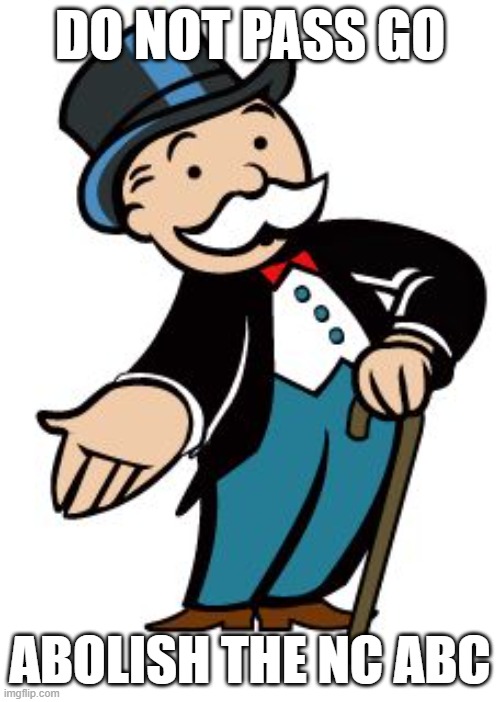
Abolish the NC ABC

Abolishing the North Carolina ABC Commission

A Libertarian Perspective on Market Liberation by Matthew Clements for NC House 56

(Note all opinions are the exclusive opinion of the candidate, not endorsed by any political party, employer or any other organization)

Executive Summary

The North Carolina Alcoholic Beverage Control (ABC) Commission operates as an archaic, state-run monopoly that severely restricts commerce, inflates consumer prices, and stifles economic growth. From a libertarian framework, the agency represents an unjustified overreach of government authority that violates free-market principles and individual liberty.

Abolishing the NC ABC Commission and transitioning to a fully privatized, competitive market will eliminate systemic government inefficiencies, lower costs for consumers, improve service delivery, and dramatically expand product access for both individuals and hospitality businesses.

Core Arguments for Abolition

1. Inherent Inefficiencies and Corruption Risks

Monopolies inherently lack the self-correcting mechanisms of a competitive market. Without the threat of competition, state-run systems naturally breed bureaucratic bloat, mismanagement, and ethical vulnerabilities.

  • Lack of Accountability: Because consumers and businesses have no alternative venue to purchase spirituous liquor, the ABC system has historically faced structural proclivities to insider favoritism, political cronyism in board appointments, and logistical mismanagement.
  • The Free-market Alternative: Privatization strips politicians and bureaucrats of the power to pick winners and losers, shifting accountability directly to consumers.

2. Substandard Customer Service to Businesses and Individuals

The current government-managed supply chain treats businesses and consumers as captives rather than valued clients.

  • The Burden on Hospitality: Restaurants, bars, and distilleries face arduous permitting hurdles, rigid ordering windows, and uncommunicative local boards. Wholesale buyers are forced to jump through bureaucratic hoops simply to acquire their baseline inventory.
  • Poor Retail Experience: Individual consumers are subjected to uniform, uninspired store layouts; rigid operating hours (including mandated Sunday closures); and a lack of staff incentivization to provide high-caliber service. Competitive private retailers, by contrast, thrive on optimizing the consumer experience.

3. Artificial Cost Inflation

The ABC Commission enforces strict uniform pricing across the state, adding multiple layers of regulatory costs and markups before a bottle ever hits a shelf.

  • Price Fixing: By eliminating price competition, North Carolina deprives consumers of the discounts, bulk pricing, and competitive sales that are standard in privatized states.
  • Hidden Bureaucratic Taxes: The operational costs of maintaining state warehouses, local board overhead, and a bloated regulatory apparatus act as a hidden tax on every purchase, artificially inflating the cost of liquor for North Carolinians.

4. Severe Restrictions on Product Access and Choice

Under the current system, North Carolinians can only purchase products that have been explicitly approved by a centralized state panel.

  • The "Spirits Desert": If a boutique distiller, a rare vintage, or a niche product is not on the state’s approved registry, it is effectively illegal to sell or purchase in North Carolina. This leaves consumers with a highly homogenized selection.
  • Suppression of Local Craft Culture: NC is home to a booming craft beverage industry, yet compared to massive corporate national brands, local distilleries face immense hurdles getting their products stocked on state shelves. A free market allows niche products to find their audience naturally through supply and demand.

The Privatization Roadmap

A transition away from the ABC model does not mean sacrificing public safety; rather, it modernizes North Carolina's economy to match the majority of the United States.


[Abolish ABC Monopoly] ➔ [Privatize Retail & Wholesale] ➔ [Transition to Standard Licensure]


  1. Liquidate State Assets: Auction off existing state-owned ABC retail properties and warehousing infrastructure to private operators, generating an immediate fiscal windfall for local municipalities.
  2. Transition to Standard Licensure: Replace state operations with a simple, non-cap licensing model for private wholesalers and retailers, similar to how beer and wine are currently managed.
  3. Preserve Revenue Responsibly: Shift from an operational monopoly to a transparent, flat excise tax system if revenue neutrality is required by the legislature during the transition phase.

Conclusion

The argument for abolishing the NC ABC Commission is a matter of both economic efficiency and fundamental liberty. The state has no legitimate role acting as a gatekeeper, retailer, and wholesaler of a legal consumer good. By dismantling this monopoly, North Carolina will foster a dynamic business environment, respect individual consumer choice, and unleash the full economic potential of its hospitality and distilling sectors.
1 reaction Share

Get Involved Volunteer Donate