

Three Amendments, One Question

North Carolina's ballot carries three proposed constitutional amendments this fall. Run each through one libertarian test and you get two yesses — one with an asterisk — and a no.
by: Rob Yates, LPNC Communications Director
This is an OpEd, and not the official position of the Libertarian Party of North Carolina.
This year, we have three proposed amendments to the North Carolina Constitution on our ballots. They’re all the way at the end, after Senate, House, NC Senate, NC House, local election, and anything else on which you might be voting, so make sure you don’t miss them.
All three were put there by the Republican majority in the General Assembly, and amendments skip the governor's desk entirely, so no veto stands between them and you. Kudos to the legislature for letting the people decide, although take that with a grain of salt, as they have run tried this before. In 2018, heading into a rough midterm, they loaded six amendments onto the ballot. Political scientists have been plain about the logic — put "taxes" and "limit" in the same sentence and base voters show up. That's no reason to vote against these. It's a reason to read them yourself instead of letting either party read them to you.
Libertarians can do that with a single test. A constitution exists to restrain the government, not the governed. So, ask of each amendment, does it increase freedom, or restrict it?
The question matters more than usual this year, because two of these amendments hinge on nearly the same sentence: the General Assembly "shall enact general laws" on the subject, "which may include exceptions." Each is a standing order to the legislature with the details left blank. What separates them is where the order points.
"Constitutional amendment to require all voters, not just those presenting to vote in person, to present photo identification before voting."
The first proposed amendment would broaden the ambit of voters required to show ID when voting. Currently, the constitution requires photo ID from voters "offering to vote in person." This amendment strikes "in person," extending the requirement to everyone, including absentee-by-mail voters.
In practice, it changes little, at least today. State law already requires mail-in voters to tuck a photocopy of an acceptable ID or an ID exception form into the envelope with their ballots. The amendment exists to move that rule out of a statute a future legislature could change and into the constitution, where it can't be touched without another statewide vote. Lawmakers approved it in a December 2024 lame-duck session, while Republicans still held the 72 House seats they needed to pass amendments without Democratic help. (The election a month earlier had already cost them the 72nd, arguably because of their failure to override the SB50 veto of constitutional carry.)
Run through the freedom test, this vote does not increase freedom. Instead, it restrains voters, and it gives the legislature a permanent constitutional mandate to decide which documents count and who qualifies for an exception. Voting is the one transaction with the state in which the citizen is supposed to be the unfettered, unrestricted boss. Requiring a government-issued credential to do it, and mailing a copy of your license to the county board to prove you're you, runs the relationship backward.
The LPNC opposed the 2018 in-person ID amendment as a solution in search of a problem, one that expands the state at the people's expense. Extending it to the mailbox doesn't change that.
This is not to say that there is no logic behind this amendment, especially in North Carolina. Mail-in voting is where North Carolina's most serious modern election-fraud scandal happened. The 2018 absentee-ballot operation in Bladen County forced a do-over of a congressional election. Supporters of the amendment argue that this is a small change to protect our elections, and that there is evidence to back up the request.
But that scheme was uncovered, the result thrown out and its organizer criminally charged, all achieved under laws already on the books. And the ID-copy rule this amendment would enshrine is already on the books, too. What the amendment adds isn't security, it's permanence. A constitution shouldn't be in the business of making burdens on citizens permanent.
Of all the ways the government can further insert itself into our lives and restrict freedom, voter ID is low on the list. It is not a significant imposition, and you are required to present ID for so many other things in your daily lives; the real issue is the government requiring you to carry government-issued papers that it can demand at its arbitrary will. (I will also note the incredible irony that the state wants a picture of you to vote, but wants to prosecute Susan Hogarth for sharing a picture of her vote. I call on everyone to post ballot selfies on November 3).
However, small imposition or not, it remains an imposition. In the humble opinion of your Communications Director, vote AGAINST this amendment.
"Constitutional amendment to keep the State income tax rate from being raised higher than three and one-half percent (3.5%)."
The second proposed amendment lowers the constitutional ceiling on the state income tax rate from 7% to 3.5%, for tax years beginning in 2027. The cap applies to "the rate of tax on incomes," personal and corporate alike.
In practice, this amendment changes nothing next April, or ostensibly in the subsequent few years. North Carolina's flat rate is 3.99% this year, and the budget enacted in July already drops it to 3.49% in 2027 and 3.24% in 2030, with more cuts scheduled after that. The corporate rate is already on a path to zero.
That's the opposition's favored refrain. Gov. Josh Stein calls the amendment a "millionaire protection cap" and argues it won't lower anyone's taxes. On the second point he's right, and it doesn't matter. This isn't a tax cut. It's a lock on the door after the tax cut, insurance against the next legislature that decides North Carolinians are undertaxed. Majorities in Raleigh change; Republicans lost their House supermajority two years ago. A constitutional cap outlasts all of them.
As for "millionaire protection," the cap protects every earner from the same thing, a rate above 3.5%. What it rules out is a graduated schedule with a top bracket above that line. Libertarians call that a feature.
It passes the freedom test cleanly. This amendment restrains government — specifically, the state's claim on what you earn. When voters lowered the cap from 10% to 7% in 2018, the LPNC endorsed it on the grounds that, while Libertarians would rather workers keep everything they earn, a ceiling is at least a step toward controlling the growth of government. Same logic, half the number.
Of course, a rate cap isn't a spending cap. A state that can't raise income taxes can still grow through sales taxes, fees, borrowing, and federal dollars, as well as by pushing costs down to counties, which raise money the old-fashioned way, from your house. That's why the two tax amendments arrived together, out of the same budget deal between Senate leader Phil Berger and House Speaker Destin Hall. Real change that benefits the economy of North Carolina and the wallets of its people will require significant cuts in spending as well.
Regardless, a tax cap is a tax cap, and tax caps that get lower are a good thing. In the humble opinion of your Communications Director, vote FOR this amendment.
"Constitutional amendment requiring limits on property tax increases by local governments."
The third constitutional amendment on the ballot this year would require the General Assembly to pass laws limiting how much local property tax levies can increase. However, it doesn't set the number. That comes later, in legislation, and "may include exceptions."
What would this amendment change right away?
Potentially a lot.
North Carolina has no state property tax; counties and cities set their own, and they've long had a reliable move. A revaluation sends home values up, the board trims the rate a little, announces a "rate cut" and collects considerably more money. State law requires local budget officers to calculate a revenue-neutral rate in revaluation years. Nothing requires the board to adopt it.
A levy limit goes after the right number. Not the rate, which officials can trim, rename and spin, but the levy, or the total dollars taken. Cap how fast that can grow and the revaluation trick stops working. Local governments have to do what households do when income doesn't keep pace with wants — set priorities.
This matters most to the people least able to fight back. A retiree who paid off her house decades ago hasn't seen her income keep pace with her assessment. Under the current system, a county commission can tax her out of a home she owns free and clear without ever casting a vote to "raise taxes." A limit on levy growth gives her something local government has never offered, predictability.
Opponents argue that one statewide limit can't fit both Bertie County and Mecklenburg. That argument doesn’t hold water, though, as the amendment limits growth, not level. The argument about county-by-county applicability takes issue with statute, not principle.
This amendment passes the freedom test. However, it comes with a giant asterisk.
Read the new sentence closely, because of what it takes for granted. It doesn't limit the property tax. It limits increases in the property tax. The constitution already assumes local governments will tax property; this amendment goes a step further and writes the tax's growth into the constitutional design, as something to be metered rather than questioned. Whatever your county levies today becomes the protected baseline. The amendment asks nothing of it.
That's a problem for libertarians, because the property tax is the purest expression of the idea that you never really own anything. Pay off the mortgage and you still owe rent — to the county, every year, for the rest of your life, on pain of foreclosure. A levy limit makes that arrangement more bearable. That's the point of it. And bearable things last. Every shocking revaluation notice puts pressure on the system and opens the question of whether homes should be taxed at all. A limit releases that pressure. A relief valve also keeps the boiler running.
The income tax amendment's sponsor, Sen. Michael Lee, pitches his measure as locking in progress. This one locks in the property tax.
Nevertheless, it is, in fact, a real limit on a real abuse, and it puts homeowners on firmer ground than they stand on today. In the humble opinion of your Communications Director, vote FOR this amendment.
Just remember, the fight doesn't end on Election Day. The number and the exceptions get written by the legislature after the vote, and "may include exceptions" is a door wide enough to drive a county budget through. And a slower increase was never the goal. The goal is a home you actually own.
Of all the proposed amendments, the thing that shines the brightest, or perhaps looms the darkest, are the amendments that aren’t there. North Carolina’s Republican-controlled legislature has, for years now, completely and utterly failed to override the veto of SB50, which would give North Carolinians the legal right to constitutional carry. Of course, bills can be overturned, while a constitutional amendment faces a higher bar to change, and is not subject to the whims of a hostile general assembly.
And, while we’re at it, nestled in the amendments that seek to restrict the government’s ability to steal your money through income and property tax is a lack of restrictions on government’s ability to spend money. It’s far past time to amend our constitution to include both constitutional carry and significant spending restrictions. Alas, that’s for another day.
Bray and Dublin to Debate as Early Voting Opens

Bray and Dublin to Debate as Early Voting Opens; Cooper and Whatley Campaigns Never Responded to Invitations
Libertarian and Green Party U.S. Senate candidates will take voter questions live on Facebook, X, and YouTube on Thursday, Oct. 15, from 7:30 to 9 p.m.
FOR IMMEDIATE RELEASE
October 8, 2026 (RALEIGH) -- Two of the four candidates on North Carolina's ballot for U.S. Senate will debate live on Thursday, Oct. 15, from 7:30 to 9 p.m., the evening early voting opens statewide. Libertarian Shannon Bray and Green Party candidate Michael Dublin accepted invitations to the virtual debate. Democrat Roy Cooper and Republican Michael Whatley were also invited. Neither campaign responded.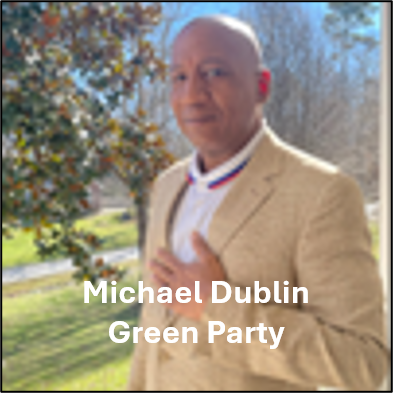
Ryan Rabah, co-founder of the We The People Party of North Carolina, will moderate. The candidates will take questions on the economy, healthcare, the war with Iran, tariffs, climate change, immigration, election integrity and voting rights, and other issues facing North Carolina.
The debate will stream live on the Libertarian Party of North Carolina's Facebook, X, and YouTube channels. Viewers can send questions during the livestream, and those who can't watch live can leave a question in the comments on the debate posts. Time permitting, the moderator may put viewer questions to the candidates at his discretion.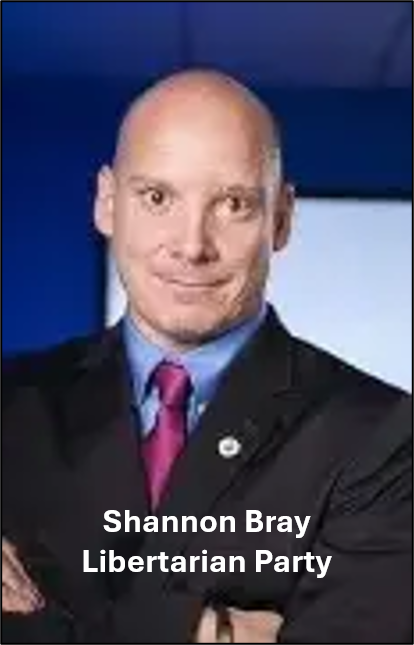
“Four candidates will be on every North Carolina ballot for U.S. Senate, and two of them agreed to stand in front of voters and answer their questions,” said Rob Yates, communications director for the Libertarian Party of North Carolina. “More North Carolinians are registered unaffiliated than as Republicans or Democrats, and that didn't happen by accident. For decades, voters have watched the two parties trade power while prices climbed, the debt climbed, and the answers stayed the same. Governor Cooper and Mr. Whatley were invited, and the invitation still stands. But this debate goes on Thursday night either way, because voters deserve to hear from everyone on their ballot.”
 According to the North Carolina State Board of Elections, 3,160,539 of the state's 7,868,625 registered voters, or 40.2%, were unaffiliated as of Oct. 3. Unaffiliated voters outnumber registered Republicans and registered Democrats alike by more than 830,000; each major party accounts for 29.6% of registered voters. Counting Libertarian and Green Party members, more than 3.2 million North Carolinians, nearly 41% of the electorate, are registered outside the two major parties.
Bray, a Navy veteran and cybersecurity professional, has made digital privacy and government accountability the center of the campaign.
“I've spent my career securing systems that can't afford to fail,” said Bray. “When a system keeps failing, you don't keep reapplying the same two patches. You find the root cause. North Carolinians have been handed the same two patches for a long time. I'm glad Michael is showing up, and I'm ready to answer any question put to me. Anyone asking for your vote should be.”
Dublin, a public school educator and community activist, is running on what the campaign calls “People, Planet, and Progress.”
“As a teacher, I never accepted ‘I was too busy’ as a reason to skip the test,” said Dublin. “Roy Cooper and Michael Whatley are asking North Carolina for six years in the U.S. Senate, and neither campaign would even answer an invitation to spend 90 minutes with voters. Shannon and I disagree on plenty, and that's the point. People deserve a real debate about the war, the economy, and who this government actually works for, not two well-funded campaigns talking past each other in 30-second ads.”
Early voting runs from Oct. 15 through 3 p.m. on Saturday, Oct. 31. Election Day is Tuesday, Nov. 3.
DEBATE DETAILS
What: North Carolina U.S. Senate Debate
When: Thursday, Oct. 15, 2026, 7:30–9 p.m. ET
Where: Online, streaming live at facebook.com/LPofNC, x.com/LPNC, and youtube.com/@lpnc
Debating: Shannon Bray (Libertarian) and Michael Dublin (Green)
Invited: Roy Cooper (Democrat) and Michael Whatley (Republican); neither campaign responded
Moderator Ryan Rabah, co-founder, We The People Party of North Carolina
Questions: Submit in the livestream chat or in the comments on the debate posts
The Libertarian Party of North Carolina is a recognized political party advocating individual liberty, civil rights, limited government, and fiscal accountability. Learn more at lpnc.org.
For media inquiries or further information, please contact Rob Yates at [email protected].
-END-
Libertarian Party of North Carolina
Libertarian Party of North Carolina (lpnc.org)
Ryan Brown
LPNC Chair
Libertarian Party of North Carolina
Ryan.B[email protected]
Rob Yates
Communications Director and Acting Press Secretary
Libertarian Party of North Carolina
Twenty Five Years Ago Today
by: Dr. Steven Feldman, Libertarian Candidate US House NC District 10
Twenty-five years ago today, nearly three thousand Americans were killed. Office workers, flight attendants, passengers who fought back. Firefighters and police who ran up the stairs while everyone else ran down, and who kept dying for years afterward from what they breathed at Ground Zero. In the years since, thousands more Americans gave their lives in the wars that followed. They deserve to be remembered on this day, too.
Before 9-11, the United States imposed sanctions on Iraq. Reports in the medical literature said the sanctions caused the death of 500,000 Iraqi children. Perhaps the reports overestimated the number. Maybe it was only 50,000, or maybe only 5,000, still more than were killed on 9-11. In 1996, Lesley Stahl asked Bill Clinton's ambassador to the United Nations, Madeleine Albright, about reports that, “half a million children have died…that’s more children than died in Hiroshima…is the price worth it?”
Albright didn't dispute the number. She said, "This is a very hard choice. But the price, we think the price is worth it." She went on to become Clinton’s Secretary of State.
https://www.youtube.com/watch?v=4iFYaeoE3n4
We are told they hate us for our freedom. Why would anyone hate us for our freedom? Bin Laden told us why he attacked us. He didn’t mention the Bill of Rights — he said children were dying under our sanctions, our troops were in their countries, and we supported what Israel was doing to Palestinian families.
Nothing justifies the violence we suffered on September 11th.
We should not support killing. Not the Americans who died, and not the Iraqi children or other families who died before September 11.
It’s not just the deaths of civilians we should mourn. The young soldiers we sent to Iraq and Afghanistan were not evil, and neither were those who fought them. Soldiers are people willing to sacrifice to protect people they love. That's the tragedy. The violence, the war, isn’t driven or waged by evil people, just really, really good, well-meaning, caring people who think violence is the solution. Bush and Bin Laden both said basically the same thing: I hate violence, but it’s the only thing the other side will listen to. Perhaps that’s why Jesus told us we should be peaceful even in the face of violence.
The lesson I take from this anniversary is that we need to redouble our efforts to be peaceful to achieve peace. It’s an approach we need now, as our country is in another war that is piling up more economic pain, high gas prices, and physical suffering. War is burning, dismembering, and killing children. Every person we kill is a parent, child or sibling of loved ones who will be angry and mourn just as we did on September 11th, 2001. And the war’s cost just adds to the debt we are leaving our children. We need to defend our borders, not kill people in other countries to make them live more like we do. More violence is not the way to leave our children a financially secure country, and it certainly isn’t a way to leave our children a more peaceful world.
Ten Absences, Nine Calendars, and the Vote Nobody Will Take
by: Rob Yates, LPNC Communications Director
"Hell is truth seen too late." — Thomas Hobbes
"The truth is permanent. Everything else falls by the wayside." — Dave Chappelle
Press Release on the 30th State Pledge
Let me give the North Carolina Republican Party its due, because it has some coming.
Credit where it's due, In March 2023, this same party did the hard thing. Governor Roy Cooper vetoed Senate Bill 41, which repealed North Carolina's pistol purchase permit — a 1919 statute that handed your county sheriff personal discretion over whether you were allowed to buy a handgun. Repeal advocates called it a Jim Crow law. A discretionary permit, in the South, in 1919, was a loaded instrument in the hands of whoever happened to be sheriff. Sheriffs continued to weaponize that power into this millennium, even to the point of being sued for their lack of responsiveness. The Senate overrode the veto on March 28. The House overrode it the next day, 71–46. Done. Law. The permit is gone and nobody has missed it.
So they can do it.
I started with that point, because the rest of this is not a story about a party that can't. It is a story about a party that won't.
What "Won't" Looks Like
Constitutional carry simply states that a law-abiding adult who can already legally own a handgun may carry it concealed without first buying a permit from the state and sitting through a state-approved class. Twenty-nine states have it. South Carolina has it. Georgia has it. Tennessee has it. North Carolina is the hole in the map, surrounded on three sides by the thingour own legislators keep promising to deliver.
Senate Bill 50 — "Freedom to Carry NC" — was filed on February 4, 2025, by Senators Danny Britt, Warren Daniel, and Eddie Settle, with nineteen more Republicans signing on as cosponsors. The Senate passed it 26–18 on March 20. The House passed it 59–48 on June 11.
Governor Josh Stein vetoed it on June 20. He did the thing a Democratic governor was always going to do, he told you in advance he would do it, and he did it on schedule. There is no betrayal in a man keeping his word to the people who elected him. We knew what we were getting with him, and there is zero utility in wasting more energy talking about it (y'all could've had Mike ROss). Put your disappointment somewhere it belongs.
The Senate overrode the veto 30–19 on July 29, 2025.
And then the House of Representatives — 71 Republicans, a chamber their party controls outright, with a Speaker their party elected — put the override on the calendar and quietly took it back off. Then did it again. And again. From August 26 to October 22, 2025, the bill was calendared and withdrawn over and over. By February 2026 the Wake Forest Law Review had counted nine scheduled override votes that never happened. On January 12, 2026, they punted to February 9. On April 6 they set it for April 21 and pulled it again. On August 10, 2026, Speaker Destin Hall told reporters, "Any bill that's on the calendar that has been vetoed, we intend to override at some point if we possibly can."
At some point. If we possibly can.
The Arithmetic is the Whole Story
Pull up the roll call from June 11, 2025. Fifty-nine ayes, forty-eight noes, and thirteen excused absences — ten of them Republicans.
Two Republicans voted no outright: Rep. William Brisson of Bladen County and Rep. Ted Davis Jr. of New Hanover County. Both are in their final terms. Neither is seeking reelection. Neither will ever stand in front of a voter again.
An override requires three-fifths of the members present and voting — not three-fifths of the chamber. Which means absence isn't neutral. Absence is currency. With Brisson and Davis voting no, the Republican ceiling is 69 ayes, and 69 only clears three-fifths if no more than 115 members cast a vote. Five Democrats have to be somewhere else that day.
Rep. Keith Kidwell, a Republican, says the real number of Republican holdouts is four, not two. That drops the ceiling to 67, and 67 only clears if nine Democrats are absent.
So the vote is hard. Fine.
Kidwell went on record and said leadership won't schedule the vote before November because, "they're more worried about losing seats than they are about doing what's right."
That is a Republican legislator saying the quiet part into a microphone. Not the Governor's office. Not a Libertarian with a grudge and a Substack. A Republican, describing his own leadership's math out loud: a recorded vote on the Second Amendment is a liability in a purple district, and the seat is worth more than the promise.
Carolina Journal found that nine of the twelve Republicans who voted no or didn't vote at all represent competitive districts. That's not a scheduling accident. That's a strategy.
And it is the same strategy as 2023, when House Bill 189 — constitutional carry, same idea, different number — died in the Rules Committee without a vote, in a chamber Republicans controlled.
Two sessions. A bill carried by twenty-two Republican senators. One veto. One override in the Senate. Nine calendar entries in the House. Zero votes taken.
What you were sold
Go find your mail from 2024. Go find the door hanger, the text message, the Facebook ad with the flag and the rifle silhouette. Somewhere on it, in a font chosen by a consultant, it says defend the Second Amendment.
Nobody wrote defend the Second Amendment when the district is safe enough.
Here's what makes it worse: they're not even losing the argument. They're declining to have it. A recorded vote that fails is a position — it tells you who stood where, and it gives you something against which we can organize. Nine withdrawn calendar entries tell you nothing, by design. You cannot primary a man over a vote he made sure not to take.
The General Assembly can still act on this until December 31, 2026. Hall says they may come back after the election. Maybe they will. But a party that needed sixteen months and nine tries to not vote on its own signature bill has told you, in the only language politicians actually speak, exactly what the promise was worth.
So be specific
There is a version of this piece where I tell you to be angry. I'd rather tell you to be exact.
This November, seven Libertarians on the ballot for the North Carolina House signed the "30th State Pledge," the same short document, in public, with their name on it.
It commits them to support every bill that removes a barrier between a law-abiding adult and a firearm. It affirms the right the Second Amendment enumerates rather than grants. And it commits them to vote for constitutional carry in North Carolina — on the record, on the floor, present in the building.
It's one page. It takes ninety seconds to read.
We keep our promises.