

Duke Power - Protected Monopoly or Responsible Public Utiility
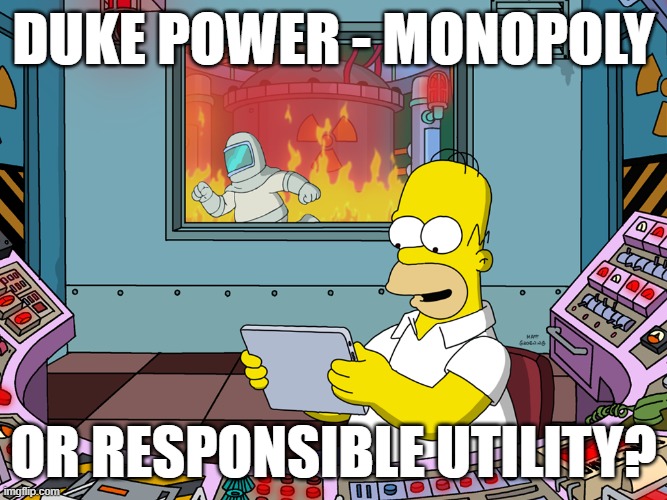
Produced by: Matthew Clements for NC House 56
(Please note that the editorial content, analysis is solely that of the candidate, not endorsed by any other individual, campaign, consultant or political party)
Executive Brief
To: Voters, Ratepayers, Policy Analysts & Stakeholders
Subject: The Economic Realities of Duke Energy’s Regulated Monopoly in North Carolina
Perspective: Libertarian / Free-Market Economics
Executive Summary
Under North Carolina’s current regulatory framework, Duke Energy operates as a state-sanctioned, governmentally protected monopoly. While public utilities commissions are theoretically designed to protect consumers, the reality mimics classic regulatory capture: a system that insulates a massive corporation from market competition, shifts capital risk from shareholders to captive ratepayers, and guarantees immense profits regardless of performance.
As demand surges from tech data centers, manufacturing, and population growth, Duke is leveraging its monopoly status to push through massive rate hikes (requesting a 15% to 18% increase through 2027–2028). From a free-market perspective, this structure artificially distorts energy prices, penalizes standard consumers, and suppresses the competitive innovations needed to naturally balance a modern energy grid.
1. Socializing the Risk, Privatizing the Reward
In a healthy free market, a business must risk its own capital to expand. If a company builds a factory or a power plant that turns out to be inefficient, the company and its investors bear the loss.
Duke Energy operates under a cost-plus regulatory model via the North Carolina Utilities Commission.
- Passing on Capital Costs: Under the Multi-Year Rate Plan, Duke is pursuing an $8.3 billion investment. Instead of funding this via standard corporate risk, the state allows Duke to pre-emptively bake future project costs directly into the base rates of everyday households.
- Guaranteed Returns: Duke’s recent rate requests seek to increase its return on equity to 95%. In a competitive market, a double-digit profit margin is earned by outcompeting rivals through efficiency and lower prices. For Duke, this high profit margin is legally mandated and extracted from a captive audience that has no legal right to choose another provider.
- Fuel Cost Pass-Throughs: Following recent extreme weather events, Duke requested the NC Legislature pass an additional $800 million in emergency fuel and purchased power costs directly onto ratepayers. Because it is legally protected from financial losses due to market volatility, the utility has weakened incentives to properly hedge against fuel price spikes.
2. The Data Center Dilemma: Distorting Subsidies
The massive influx of data centers and advanced manufacturing in North Carolina is driving a projected 16% to 60% increase in net electricity load over the next 15 years.
In a market economy, a sudden surge in demand from a high-volume commercial buyer would be resolved through custom, risk-adjusted contracts, or private, on-site industrial generation.
Instead, the current system risks creating a public subsidy: Residential ratepayers are seeing their bills jump by an estimated $17 to $23 a month to fund grid modernization and capacity expansions that are largely being driven by massive tech corporations.
Under a monopoly, the capital expenditure gets rolled into the general "rate base," meaning standard households are effectively subsidizing the infrastructure required by private tech giants.
3. Suppressing Market-Driven Solutions
A competitive energy market allows prices to fluctuate freely, signaling to entrepreneurs exactly where, when, and how to deploy new power-generation technology. Duke’s monopoly actively stifles this optimization across all energy sectors.
Renewable Energy & Decentralization
In an unhindered market, businesses and residential clusters would actively deploy decentralized solar and battery storage systems, selling excess power back to an open grid at true market value. In North Carolina, Duke tightly controls interconnection standards and net metering rules. By restricting competitive power purchase agreements, the state prevents independent clean-energy producers from competing face-to-face with Duke's centralized assets.
Nuclear Power & Next-Gen Tech
Nuclear power provides highly reliable, emission-free baseload power (supplying over 30% of NC’s electricity). However, monolithic utilities rely on massive, multi-billion-dollar large-scale reactors, because their cost-plus model rewards large capital projects and gambling on those projects since the rate-payers are the ones on the hook for the projects, not the share-holders. A free market would allow private investment to pivot toward agile, cost-effective small modular reactors funded by private capital rather than long-term, ratepayer-funded debt.
Demand Response & Customer Choice
A true market relies on dynamic, real-time pricing. If data centers face high spot-market prices during peak hours, they naturally adapt by shifting their computing loads or relying on their own backup generation. Because Duke’s monopoly buffers consumers and large entities from direct market exposure, the system lacks the flexible, price-driven "demand response" mechanisms that naturally prevent grid strain without requiring billions in heavy-handed infrastructure buildouts.
Free-Market Policy Alternatives
To protect ratepayers and foster an abundant, reliable grid, North Carolina should move away from command-and-control utility regulation and toward market liberation by taking the following steps:
- Retail Choice / Deregulation: Break up the vertical monopoly. Separate power generation (which should be fully competitive) from power distribution (the physical lines). Allow consumers to choose their retail electricity provider just as they do with internet or insurance.
- Enforce Strict Cost-Causation: Legally bar utilities from shifting the infrastructure costs of ultra-high-load commercial users (like 100MW+ data centers) onto residential rate bases. Large users should pay the literal, marginal cost of their hookups.
- Legalize Microgrids and Third-Party Sales: Allow property owners, solar developers, and private communities to generate and sell electricity directly to one another without being classified or restricted as public utilities.
Conclusion
The current rise in North Carolina utility bills is not a failure of the free market; it is the predictable outcome of state-protected corporatism. When a single entity is granted a legal monopoly, guaranteed profits, and the ability to pass all capital risks onto an audience legally forbidden to leave, prices will naturally rise while consumer leverage plummets. True relief for ratepayers will only come by exposing Duke Energy to the disciplinary forces of open market competition.
Sources:
https://www.solar.com/learn/duke-energy-carolinas-rate-increase/
https://www.duke-energy.com/home/billing/dec-nc-rate-case
https://www.carolinajournal.com/duke-energy-seeks-rate-hike-after-early-2026-cold-snap/